
The farm shop is the only channel where you own everything: the price, the meeting, the story and the place. It's also the channel with the best margin – but it's paid for with your time (run the numbers in the deep dive). This section is about what decides whether the shop carries itself: understanding why the customer really comes, and doing something with it.
The customer buys the morning – not just the cheese
Nobody drives twenty minutes of gravel road to shop cheaply. The research behind the farm-shop programmes is clear: people long for origin, real food, calm and nature – and the farm shop is one of the few places where all of that is real. The customer buys a morning in the countryside, and carries the cheese home as a memory.
That means three things in practice:
- Your shop is a destination, not a grocery store. The competitor isn't the supermarket – it's every other way to spend a free morning.
- Price accordingly. Someone who's had an experience doesn't compare your price with the supermarket shelf (set your price).
- Count the visit, not just the receipt. A happy visitor comes back, brings friends and talks about you – that's your cheapest marketing.
The place is the product
The customer starts experiencing your shop long before the door. Walk the customer's path – literally, phone in hand – and look at every step as a first-time visitor:
- The sign by the road – can it be seen, and does it promise something?
- The parking and the yard – welcoming or back lot?
- The door – is it clear where to enter, and when you're open?
- The room – what meets the nose, eyes and ears in the first three seconds?
- The meeting – does the customer feel seen? You're a host, not a cashier: the meeting is what the customer travels for.
- The farewell – what does the customer take along, besides the goods? A taste, a story, a reason to come back?
Do the walk once a month and photograph what chafes. Three photos = this week's to-do list.
The neighbour isn't a competitor – you're the same outing. The customer who found their way to you often wants one more stop. Swap signs and brochures with two or three neighbours (the shop, the café, the brewery) and actively recommend each other. Places people love to visit are built together.
The story that sells on site
Your story is what separates your shelf from a market stall. Four things make it genuine instead of salesy:
- Who's listening? Tell it to your most important visitor, not to everyone.
- True foundation. Start from what actually happened – the farm, the generations, the mistakes.
- A protagonist. Someone to follow: you, the family or the place.
- A why. It should be easy to understand why you're telling exactly this.
This is the same story you wrote in the brand brief – now it goes into the shop: five sentences on a sign by the till, one line on the shelf edge for each product, and a 30-second version you can say out loud when someone asks. Practise it. It's the best-selling item in the shop.
The shop's digital shop window
Almost every visit starts on a phone. Two things go a long way:
Your Google Business Profile is the shop's most important digital surface. Opening hours that are correct, fresh photos, the right pin on the map and answers to reviews – that's the difference between a car in the yard and a customer who gave up. Follow the guide in Marketing step 3 and book a monthly check.
Tell it in four layers. You, the shop, the place and the region strengthen each other: a post about you builds trust, one about the shop shows what's in today, one about the place gives a reason for the outing, and the region's pull you borrow for free. Make content that helps the visit – the way here, what's freshly harvested, who the customer will meet (choose channel and rhythm in Marketing step 4).
The practical bits
- Opening hours you can sustain. Better short and reliable than long and cancelled – nothing kills trust like "closed" when Google said open. Build around your season.
- Self-service extends the season. An unstaffed corner with Swish and a fridge can keep the shop "open" when you can't be there – many succeed with trust as the business idea.
- Make paying easy. Swish and card, both. Tourists rarely carry cash.
- The rules in one sentence. If you sell food, the business must be registered with the municipality, and packaged goods must be correctly labelled. Check with your municipality – it's simpler than it sounds.
When you're done: My farm shop
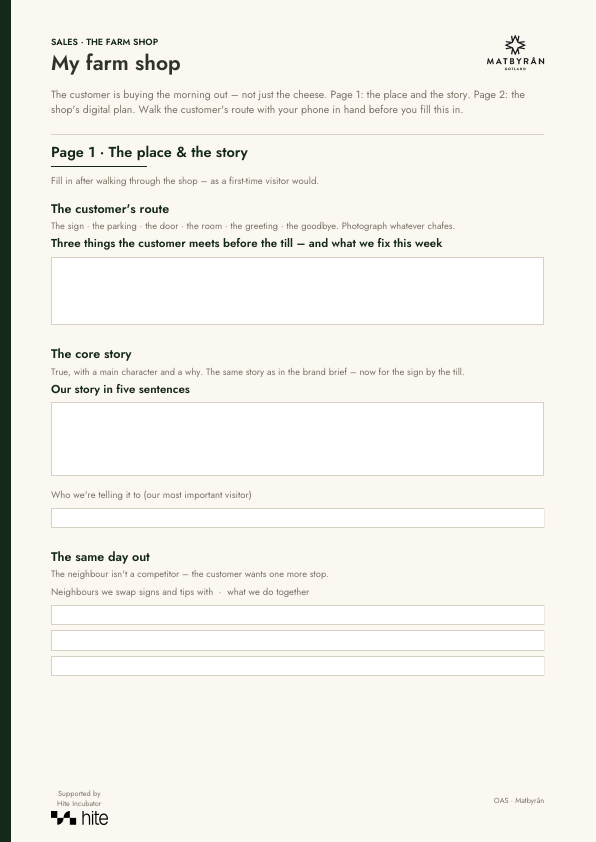
Fill in the worksheet: page 1 is the place and the story (the customer's path, the core story, the neighbours), page 2 is the shop's digital plan (the business profile, the content, the rhythm).
Do this next
Walk the customer's path through your shop today, phone in hand. Photograph three things that chafe and fix them this week. This is the last step of the sales journey – if you skipped one, the module overview takes you there.
This section builds on the business development programme for Gotland farm shops, led by Linton & Skantze (2024–2026).