
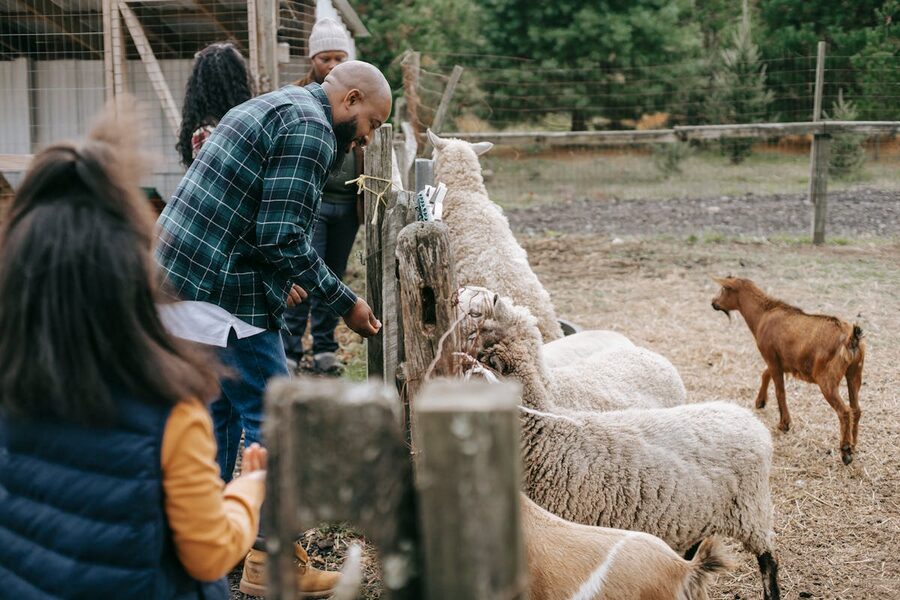
Regenerative thinking comes from farming and ecology. The core idea is simple: a system shouldn't merely hold together – we can actively build up what we are part of, rather than wear it down.
Carried over into business, it means shifting your gaze. Sustainable is doing less harm. Regenerative is actively contributing to vitality – of the place, of nature, of the people, and of the business itself.
Instead of asking "how much can we grow?", a regenerative business asks "how do we become stronger, more rooted and more durable over time?"
It isn't necessarily about getting bigger, but about becoming more resilient – for you as a business owner, for the place, and for the context you work in. And it isn't vague. On the contrary, it becomes very concrete as soon as you apply it to your own business. This module is built for exactly that: taking something that can feel large and abstract and turning it into questions you can actually ask about your company.
Why it matters for the place
How you build your business affects more than your own bottom line. Research and statistics point to three ways small, place-rooted businesses build society:
- The money stays and circulates locally. When a customer buys from you, and you in turn buy from your neighbour, the money circulates in the area instead of leaving it. The idea is captured by the measure LM3 (Local Multiplier 3), developed by the British think tank New Economics Foundation.
- Resilience in a crisis. The more viable small-scale food businesses spread across the country, the less vulnerable the whole food system is to any single disruption. LRF puts it as: profitable businesses in peacetime are the foundation of secure supply in crisis – every viable small food business is part of Sweden's preparedness.
- The attractiveness of the place. On Gotland, local producers of beer, wine and whisky are held up as part of what makes the island worth visiting – visitors experience a place as more genuine when what they meet actually comes from there. Small-scale producers are rarely interchangeable, and that is exactly why they matter.
So when you build regeneratively you aren't only adding to your own vitality – you are building the place's economy, resilience and identity.
Three steps – at your own pace
This module is the foundation for the whole journey, and it is short on purpose:
- Six perspectives – and your why at the centre – the compass that leads, step by step, to why the business exists.
- Grow outward, not just upward – growth through cooperation instead of expansion on your own.
- Your regenerative business model – everything gathered on one canvas, with your why at the top.
What you land on here returns throughout the programme: the team and the life, the brand's why, finance as steering, marketing and sales – the same stance, applied.
Selected sources: the Swedish Board of Agriculture, MSB, LRF, the Swedish Riksdag, New Economics Foundation (LM3), Linköping University, Region Gotland.