
The most common mistake among small food producers isn't the wrong channel – it's a price that's too low. Three traps account for almost all of it: covering only the raw materials and forgetting your own time, settling on "the same as everyone else", and accepting the wholesaler's or store's first offer. This section gives you a staircase in three steps: calculate your floor, read the benchmark – and dare to charge your premium.
The floor: count backwards
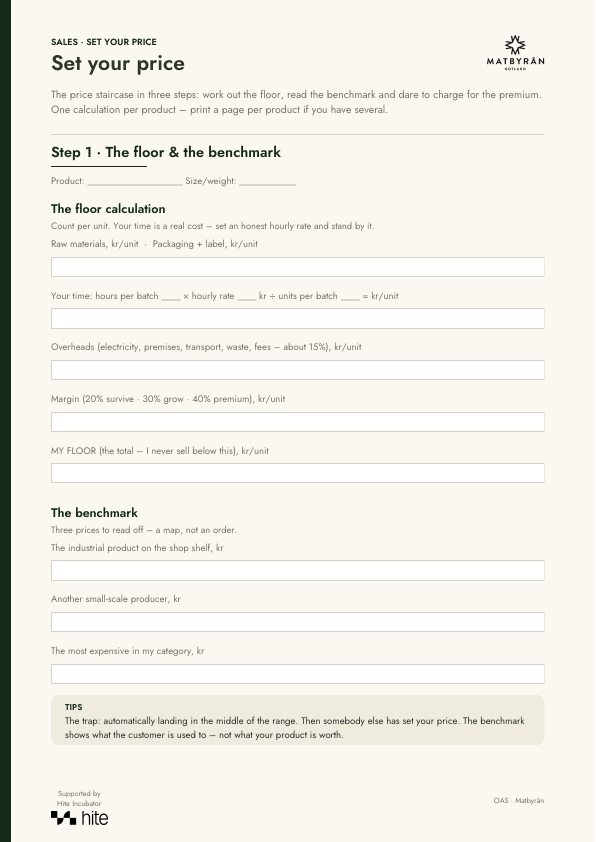
Your lowest price isn't an opinion – it's a calculation. Count per unit:
Raw materials + packaging + your time + overheads + margin = the floor.
The calculator below is pre-filled with an example – a jar of artisan jam that lands at 68 kr. Swap in your own numbers. Two things to stand by: your time is a real cost (set an honest hourly rate) and the margin is no luxury – it pays for broken equipment and failed batches. A price that only covers the raw materials is a hobby, not a business. Below the floor you never sell, in any channel.
Calculate your floor
Enter your numbers – the floor updates instantly. Pre-filled with the jam example. Unsure about the percentages? 15% overheads and 20% margin are reasonable starting values – see the boxes below the calculator.
Below this price you never sell – in any channel.
What margin should I have? Rules of thumb▾
The margin is what's left when everything else is paid – and there are no laws, only rules of thumb:
- 20% is the floor, not the goal. It's enough to survive the unexpected: broken equipment, a failed batch, a rainy market weekend. Start here if you're new.
- 30% gives room to grow – investing in better packaging, a fair, more raw materials for next season. This is where most established small producers want to be.
- 40% or more belongs with premium – products with a strong story, a short season (the margin must carry the whole year) or the gift market, where price sensitivity is low.
Two more things: seasonal products need a higher margin per unit, because volume is capped. And remember what the chain does to your price – the store often adds 30–45 percent on top of your trade price, and through wholesale you often get only 50–60 percent of the consumer price. Your margin has to survive that.
Overheads people forget – the checklist▾
The 15 percent is a rule of thumb – count your own once a year. Common items that get forgotten:
- Waste and failed batches – count on 5–10 percent; everyone has them, few book them.
- Electricity, water and cooling in production – even when it happens at home.
- The premises – rent, or wear and heating in your own barn.
- Transport and fuel – the trips to the market, the deliveries to the store.
- Fees – market stalls, Swish/card (1–2 percent), the municipal food inspection, any certifications.
- Transport packaging – cardboard, cool boxes, labels that go wrong.
- Tastings and free samples – they sell, but they cost.
- Bookkeeping and insurance – the dullest, most often forgotten.
The benchmark: look around
Check three prices before you decide: the industrial jam on the supermarket shelf (35 kr), another small-scale producer (75 kr) and the most expensive in your category (110 kr). Now you can see the span. But the benchmark is a map, not an order – settle automatically in the middle and someone else has set your price for you.
The premium: charge for what makes you special
Your jam doesn't compete with the industrial jar – they sell sugar, you sell berries from your field, a craft and a story. It's your why, on a price tag. Here's how you find your premium – listen for the evidence:
- What do customers say when they come back? ("You can taste the strawberries" – that's value.)
- What do they photograph and talk about? (The farm, the label, the bread in the basket.)
- What do they ask about? (Origin, recipes, the animals – the questions show what they care about.)
Write down the three strongest pieces of evidence and put your price above the middle of the benchmark span – in the example 85–95 kr, not 75. Too cheap says "nothing special". And if you always sell out, you don't need more customers – you need a higher price. Standing by your price is what we train in the sales conversation.
Several channels – one price logic
If you sell in several channels, one rule above all: don't lower the price in your own channels because the wholesaler pays less. Your trade price to stores and wholesalers is lower because they add their markup – but the customer's price on the shelf should land at roughly the same level as at your place. Count backwards from a recommended consumer price: after deducting the store's markup, your trade price must still sit above the floor – otherwise you say no thanks (run the numbers in the deep dive).
In the farm shop and at the market you keep the whole margin – sell cheaper at home than the store and you're competing with your own retailers, teaching customers to wait for the "farm price". And VAT: business prices are quoted excluding, consumer prices including – and food VAT is currently temporarily cut to 6 percent (from 12, through 2027) and can change with politics. Check Skatteverket, and never build your calculation on a temporary VAT rate.
Deep dive: run the numbers on your channelsThe Excel tool that compares what each channel actually gives – download, fill in, compare.→Raising your price
Most small producers sit too low and wait too long. Three things make a raise undramatic: do it at a natural shift (new season, new label, new range), briefly say why if someone asks (raw materials, craft, small scale) – and do the maths in advance: raise the price 10 percent and keep 9 out of 10 customers, and you earn more than before, with less work. The customers who leave over a tenner were rarely your right customers (customer segments again).
Three tricks on the sign
- Round prices for craft. 85 kr signals quality; 84:90 signals discount. Leave the öre to the chains.
- Give a reason on the shelf edge. One line – "hand-picked berries from the farm" – makes the price make sense without you standing next to it.
- Build bundles instead of discounts. "3 for 240" or a gift box raises the average purchase without lowering the value of a single jar.
When you're done: your price list
Do this next
Calculate the floor for your best-selling product tonight – with an honest hourly rate. If today's price is below the floor, you've found this week's most important task. Next step: the sales conversation.