
The meeting with the restaurateur, store manager or buyer is rarely decided in the meeting – it's decided by how you think about it. Nervous sellers talk product; good sellers ask questions. Your job in the first meeting is not to sell. It's to find three problems at the customer's end that your product solves – and to book the next step.
Before the meeting: do your homework
Ten minutes of research shows immediately in the meeting:
- The business. Read the menu or walk the shelf. What do they highlight – local, seasonal, craft? What's missing? New ventures, a new chef, a rebuilt store?
- The person. A look at Instagram or LinkedIn: what do they care about, do you share acquaintances, what have they said in the local paper?
- Your angle. One sentence that connects you: "Your menu champions the local – my lambs are born five kilometres from here." Without an angle you're one of many; with one, you're already halfway.
When you book the meeting: write briefly what it's about and a minimal agenda (how you work today · what I do · a possible next step). Confirm the time and whether someone else should join – in a restaurant it's often the chef and whoever handles purchasing.
Open like the doctor
Be honest about what the meeting is – it takes the nerves out of it for both of you:
"Good to meet! Let's do this a bit like a doctor's visit: we go through what works in your range, what chafes, and whether what I do could be a solution. If what I have fits you – I'll say so. If it doesn't – I'll say that too, and we've both saved time. Sound fair?"
Then: check the time ("do you have a hard stop?"), and ask them to tell you about the business first. Your questions start there.
Ask first – find three pains
Open questions, one at a time, and listen more than you talk:
- "What in your range works best today – and what chafes?" (Start with what works; follow the thread until the problem comes into focus.)
- "What have you tried to solve it?"
- "How long has it been like that?"
- "What does it cost you – in kronor, time or irritation?"
- "What would it look like solved?"
The most common pains for restaurateurs and store managers: suppliers who don't keep their promises, a range that looks like everyone else's, guests asking for local without the shelf being able to answer, and categories with lousy margins. Write down the three pains you hear – in the customer's own words.
Then – and only then – your product
Mirror back what you heard and connect your product to each pain: "If I understand you right: guests ask for local, the last supplier messed up deliveries, and the cheese you carry doesn't stand out. Here's what I can do about all three …"
And show a little, not everything – here you have an advantage the average B2B seller lacks: the tasting. Bring three products, not the whole range, and let the taste make the argument. Your 30-second story (you practised it in the farm shop section) belongs here – and you stand by your price with the premium from step 2 behind you.
Book the next step before you stand up
A good meeting that ends with "let's keep in touch!" is a lost meeting. Propose something small and concrete while you're still sitting: a trial delivery, three weeks on the shelf, a visit to the farm. Book the date on the spot and confirm who else should join.
When it chafes: two answers to know
- The mirror. Customer: "It's too expensive." You, calmly, stressing the last word: "Too expensive?" – then silence. Let the customer explain; they usually negotiate with themselves and tell you exactly what it would take.
- The counter-turn. Agree – and explain why: "Yes – because the berries are hand-picked and the batches are small. That's also why your guests will taste the difference." The price isn't a mistake; it's part of the story.
A no is also an answer
If you get a no: say thanks and ask "what would have needed to be different?" – the answer is free advice for the next meeting. And if you give something in a negotiation (price, free delivery), take something back: a spot on the menu with your farm's name, an introduction to the sister restaurant, a reference.
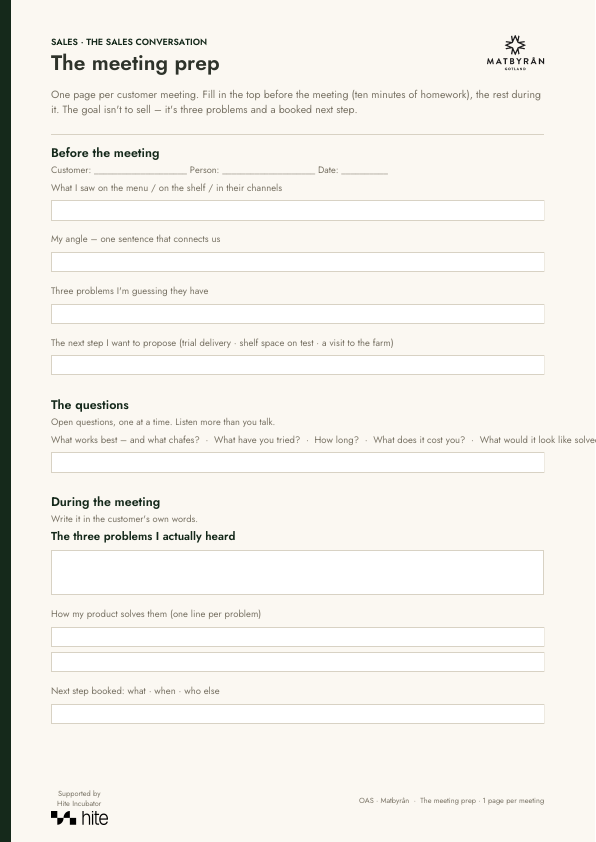
When you're done: the meeting prep
Do this next
Pick a restaurateur or store you want in at. Do the ten-minute homework, write your angle and book the meeting. Next step: selling to restaurants and stores – what happens after the customer says yes.
This section builds on Theodor Zätterström's B2B sales bootcamp for Science Park Gotland, adapted for small-scale food producers.