
No team falls apart overnight. The cracks come slowly – through unspoken assumptions, uneven load and expectations that were never tested against each other. This step you do together: one evening, phones off, one filled-in profile each from step 1 on the table. The goal isn't perfect harmony – it's clarity with warmth.
Start with the profiles
Read your profiles aloud to each other. What did you recognise in the other person? What surprised you? Ask especially about the saboteurs: "What does it look like when mine takes over – and how do you want to tell me?" Asking for that flag in calm times makes it possible to give in pressed times.
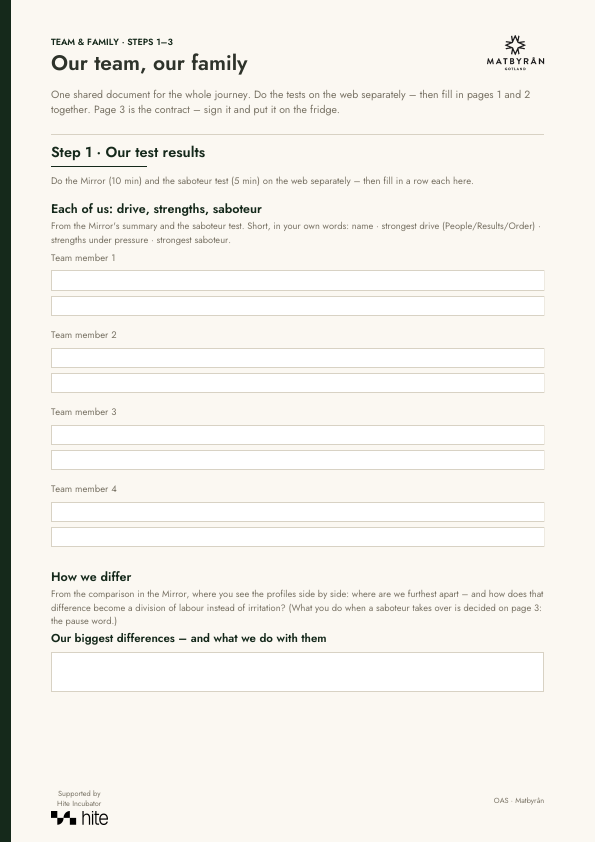
Did you do the Mirror in step 1? Paste your codes into the comparison view and you get two things: your profiles side by side – where you differ, and why that's usually division of labour rather than fault – and, if you've also rated each other, the mirror image: the gap between self-image and others' image. Where the pictures differ lies the evening's most important conversation – start there.
Interactive tool
Compare your Mirror codes
Paste everyone's codes into the comparison view – the tool shows your profiles stacked side by side (works for the whole team, not just two) and mirror images where someone has been rated by others.
Open the tool →Free · no login · nothing leaves your browser
Extra fuel – three stories: ask three people who know you well (a customer, a neighbour, an old colleague) for one short, concrete story each about when you were at your best. The recurring patterns are your strengths, witnessed from outside – hard to argue away, easy to be warmed by.
The tension map
Rate separately, 1 (calm) to 5 (chafing), then compare:
- Money, salary and personal draws
- Working hours and the season's pace
- Roles – who does what, and who does most?
- Home vs work – when are we colleagues, when are we family?
- How decisions get made
- Generations and relatives around the business
Where your numbers differ most, the most important conversation lives. Talk about the two or three biggest gaps – not everything at once.
The what-if conversations
Healthy teams dare to talk about the uncomfortable before it happens – it's risk management for relationships, not pessimism. Take these four, and write one sentence on how you'd handle each:
- What if one of us wants to quit or move?
- What if one of us hits the wall?
- What if one of us under-delivers for a longer period?
- What if we completely disagree on the way forward?
Note for the legal side: the answers to the what-ifs are exactly the input a lawyer needs for a partnership agreement (ownership, exit, money). The contract in the next step is the relational layer – the legal layer you handle separately, e.g. via verksamt.se or a lawyer.
What is "enough"?
Founders often assume they want the same thing – until it's tested. Tell each other: what do you personally want from the company in 1, 3 and 5 years? And what would be enough – even if it never gets big? Where your pictures differ, nothing is wrong; it just needs to be on the table now, not in three years.
When you're done: page 2
Fill in the worksheet's second page together: your biggest tensions, your what-if answers and your pictures of "enough". That's the clay the contract is shaped from.
Do this next
Book the next evening right away, while the conversation is warm. Next step: The contract – where everything you've talked about becomes one page on the fridge.