
Before you can build a healthy company together, you need to understand the person bringing the energy into it: you. This step is done alone – one evening, pen and paper. Everyone in the team does the same, separately.
Your values
Values steer decisions when facts are missing – and they are the first thing founders clash over. Choose your five most important values (e.g. honesty, freedom, security, quality, family) and write one line about each: what does everyday life look like when it's honoured – and how does it feel when it's violated? If you've done the core values in Brand step 2 you'll recognise the exercise – but these are your personal values, not the company's.
What drives you
People are driven differently. Someone gets energy from people – helping, creating belonging. Someone from results – pushing forward, getting things done. Someone from order – getting it right, clear and well thought through. No drive is better than another, and most of us are a blend.
But under pressure one takes over – and that's where friction starts. The results person experiences the order person as a brake; the order person experiences the results person as careless. Both have good intentions. Once you see that, you stop reading bad will into your co-founder's behaviour.
The Mirror: let the team correct your self-image
Here's the catch with every self-test: we have blind spots. Research shows that people who know us well often judge parts of us more accurately than we do ourselves – especially how we behave under pressure. In a family team, that knowledge sits at the kitchen table. So we built the Mirror – our own free tool, no login: you rate yourself on 35 statements (10 minutes) and get a personal summary of what your profile tends to mean in everyday life as a small business owner. Then your teammates rate you on the same statements, and the tool shows the difference – what others see that you don't. The gap isn't a grade; it's your best conversation material. Rate yourself high across the board? Then the tool reads the pattern relative to your own average – and asks a few quick either/or questions to find the differences.
Interactive tool
The Mirror – how you see yourselves and each other
35 statements, about 10 minutes. You get your profile, a personal summary as a business owner – and a sharing code so the team can compare their pictures with yours. Save the code in the worksheet.
Open the tool →Free · no login · nothing leaves your browser
If you also want a scientifically validated test, there's bigfive-test.com – free, open source, no account, with a built-in comparison feature for partners and family (10 min).
Your saboteurs
Under stress our strengths over-fire until they trip us: care becomes avoidance, drive becomes attack, thoroughness becomes nit-picking. Those patterns are called saboteurs, and everyone has them. Note your top 3 and reflect: how do they show up under pressure – and what do they cost the team?
Free test
The saboteur test – your inner opponents
5 minutes, free. The test shows which of the ten saboteurs (inner voices that take over under stress) are strongest in you. Write your top 3 in the worksheet.
Open the test →Free · in English · results sent to your email
The strength is the way through the saboteur
Here's how the two tests connect: the saboteur is usually your strongest drive in stress mode. Same engine – wrong gear. That means the counter-move isn't becoming someone else, but deliberately shifting back into the mature form of your strength:
- People-driven? Your most common saboteurs are the Pleaser (says yes to everything) and the Avoider (ducks the uncomfortable). The counter-move is your own strength used right: you're the best in the room at hard conversations – once you take them. Use your care to say the difficult thing kindly and early, instead of sparing everyone until it cracks.
- Results-driven? Watch for the Hyper-Achiever (never enough), the Controller (must steer everything) and the Restless (next project before this one is done). The counter-move: point the drive at the right targets – make recovery, delegation and the 90-day check tasks to tick off. Then the engine works for you again.
- Order-driven? Your shadow is called the Stickler (nothing gets finished) and the Hyper-Vigilant (sees risks everywhere). The counter-move: use your structure to schedule ”good enough” – decide the done-criterion in advance, so the order protects the delivery instead of stopping it.
First recognise the saboteur behaviour (the test), then get through it with the strength you already have (the Mirror shows which one – and what the team sees). The gap between your picture and theirs is often exactly where a saboteur works unseen.
Your warning signs
Founders rarely run out of ideas – they run out of energy. Write down: what charges you, what drains you, what your early signs are that you're about to break (short fuse? sleep? withdrawing?) – and what helps you recover.
When you're done: Our test results
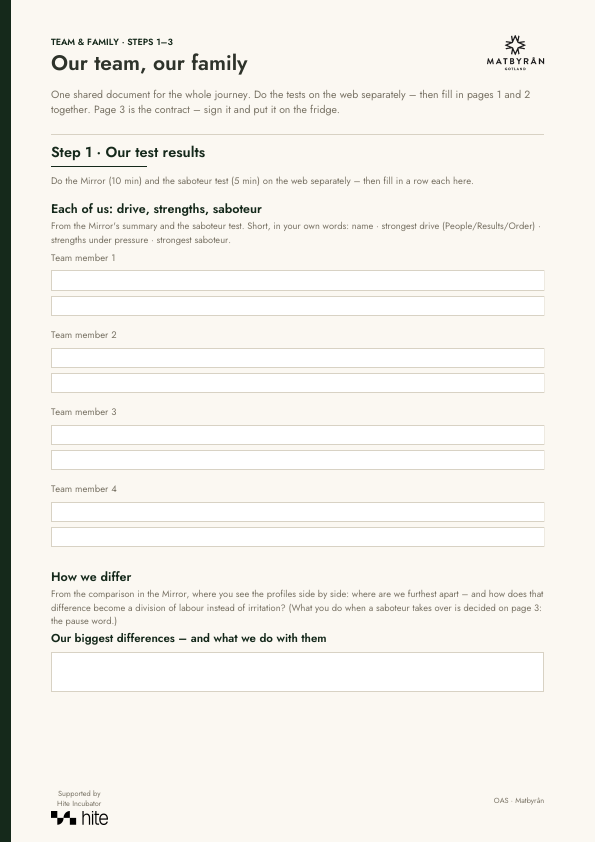
Fill in the Our test results page of the worksheet – it's one shared document for the whole team. One row each: name, strongest drive, strengths under pressure and top saboteur – and at the bottom, your biggest differences from the Mirror comparison. Short on purpose – the notes aren't the point, the conversation in the next step is.
Do this next
Book the evening when you do the next step together – and bring one filled-in profile each. Next step: Understand each other.