
All marketing starts with a simple but valuable insight: people don't think like you. You know why your food is special. The customer knows none of it – yet. And your "one" customer is really several different customers.
This section helps you break your customer down into a few different segments – clear groups that buy for different reasons, in different places. Once you know who they are, you can define where and how to market to them.
Stop saying "everyone"
It's tempting to answer "surely everyone wants my food." But marketing to everyone reaches no one. When you break your customers down into segments, everything gets sharper: the right message, the right channel, the right price,.
The goal is 3–4 segments. Any more becomes unmanageable. No fewer – you miss the differences that matter.
Two kinds of customer: individuals and businesses
Most producers sell to a mix. Separate the two – they work completely differently.
Individuals – buying to eat themselves. Example segments:
- The local regular – lives nearby, buys regularly, values closeness and relationship.
- The conscious food lover – seeks quality, organic and origin, happy to pay a little more.
- The gift / occasion buyer – buying for a present or an occasion, wants something special.
- The visitor – the tourist who wants a taste of Gotland to take home.
Businesses and organisations – buying to resell or serve. They value reliable supply, consistent quality and volume, margin, and a story they can pass on to their own customers. Examples:
- Wholesaler / distributor – volume and reliability above all.
- Restaurant / café – quality and a story that dresses the menu.
- Shop / farm shop – something that stands out on the shelf.
- Public-sector kitchen (municipality, school, care home) – procurement, price, supply reliability and ideally local origin.
- Event / catering – volume on single occasions.
You don't need them all. Pick the 3–4 most real for you – ideally a mix of individuals and businesses if you sell both ways.
How to build your segments
Do this – alone, with your family or your team:
- Look at the ones you already have. Already in business: who actually buys from you today? Who comes back? Write down the clearest types – reality is a better starting point than guesses.
- Add the potential ones. Which customer types are out there that you don't reach yet, but should be able to?
- Group into max 3–4 segments. Merge the ones that resemble each other. Give each a short, recognisable label.
- Describe each segment using the questions below – they make the differences clear.
- Draw the conclusion – what does each segment mean for where and how you market and sell? This is what steers your channels, message and price later on.
This is the foundation for everything that follows. Better to spend an hour here than ten hours on the wrong channel.
Six questions that make the segments clear

The most common trap is stopping at the surface: "women 30–60 who like sustainability." That tells you nothing about what to do. Instead, ask these questions about each segment – the answers go straight onto the segment card:
- In what situation do they buy? The weeknight dinner, the gift, the weekend visit, the holiday – or the delivery to the kitchen?
- What do they value most? Pick 2–3: taste and quality · local and origin · clean ingredients and health · sustainability and ethics · price and convenience · relationship and story.
- Where do they find you – and where do they want to buy? Google, Instagram, the market, the road sign, a friend's recommendation? The farm shop, the store shelf, home delivery?
- What do they buy otherwise? The supermarket, another producer – or nothing at all?
- What makes them hesitate? The price, the hassle of collecting, not knowing how to use the product?
- What makes them come back? The taste, the relationship, the convenience, the season?
No customer cares about everything. The one who chooses you for local and relationship is not the same customer as the one who chooses you for price and convenience – that difference is exactly what the questions are there to capture. And age or gender is never the answer to any of them.
The test: if two groups answer the questions the same way, they're one segment – merge them. If the answers differ on two or more questions, you have two segments.
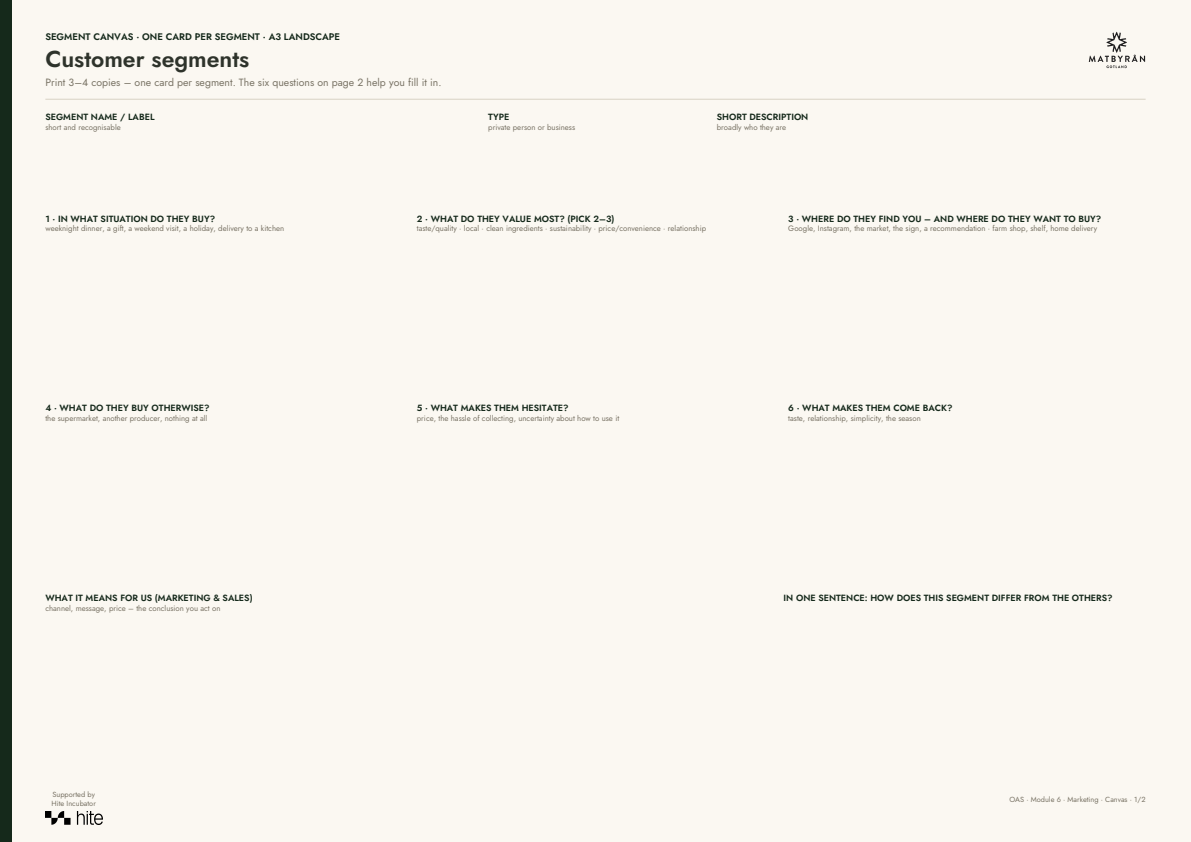
When you're done: one card per segment
What you should have in hand when this part is finished: one filled-in card per segment – 3–4 cards that together show your segments, clearly distinct. Each card answers the six questions, plus what the segment means for your marketing.
Do this next
Map your 3–4 segments: which you have today, which are potential, and fill in one card per segment. Keep the cards – they're the first piece of your plan, which you put together in step 6. Next step: the customer journey — the path from first time to regular.