
A customer rarely becomes a customer all at once. Most people go through several steps along the way, and each step needs something different from you. Once you know where a customer is, you also know what to do next.
Picture a funnel: many notice you, fewer consider, a few buy – and only a few per cent of those who see you today are ready to buy right now. But the journey doesn't end at the purchase. After the purchase the funnel opens up again: a happy customer comes back, tells others – and refills the funnel from the top. That's the journey, in five steps, that we walk through here.
The five steps
1. Awareness — they learn you exist
What happens: someone hears about you for the first time – via a neighbour, a post, a sign, a search.
What they need: a clear and honest first impression of who you are and what you do.
What you do: show up where they are (markets, Google, social media) with a clear first impression.
Critical question: Where do you appear when someone who doesn't know you comes across you?
2. Consideration — they compare you to alternatives
What happens: the customer thinks it over, compares, reads reviews, looks at your page.
What they need: reasons to trust you and choose you in particular.
What you do: make it easy to understand what you offer, show social proof (reviews), and tell your story.
Critical question: Why you instead of the neighbour?
3. Decision — they make up their mind
What happens: the customer is ready to buy or book.
What they need: it to be easy. No obstacles.
What you do: make the purchase or booking smooth – clear price, few clicks, correct opening hours.
Critical question: Is it easy to buy from you right now?
4. Experience — they buy and meet you
What happens: the customer buys, visits or receives the delivery – the first real encounter.
What they need: it to match, ideally exceed, expectations.
What you do: deliver quality and a warm welcome. This is where your reputation is built.
Critical question: Does the experience live up to what you promised?
5. Follow-up — they come back or tell others
What happens: the time after the purchase. The customer can become a regular and tell others – or forget you.
What they need: a reason to come back, and to feel remembered.
What you do: stay in touch (newsletter, a greeting, ask for a review) and give them something to come back for.
Critical question: Have you given them a reason to come back – and to tell others?
Finding new vs nurturing the ones you have
The first two steps (awareness and consideration) are about finding new customers. The last two (experience and follow-up) are about nurturing the ones you already have. Both are needed – but most people put all their energy into finding new and forget to nurture.
That's a shame, because a customer who makes it all the way to follow-up and tells others is worth far more than a new one who buys once. That's true for both individuals and businesses.
Different steps, different tools
Later in this module we go through the tools – search and Google, social media and your website. It helps to know which step each tool supports:
| Step | What helps most |
|---|---|
| Awareness | Social media, markets, Google |
| Consideration | Reviews, your website, your story |
| Decision | A simple website, clear price, easy booking |
| Experience | Quality and welcome in person |
| Follow-up | Newsletter, reviews, personal contact |
When you're done: a map of the journey
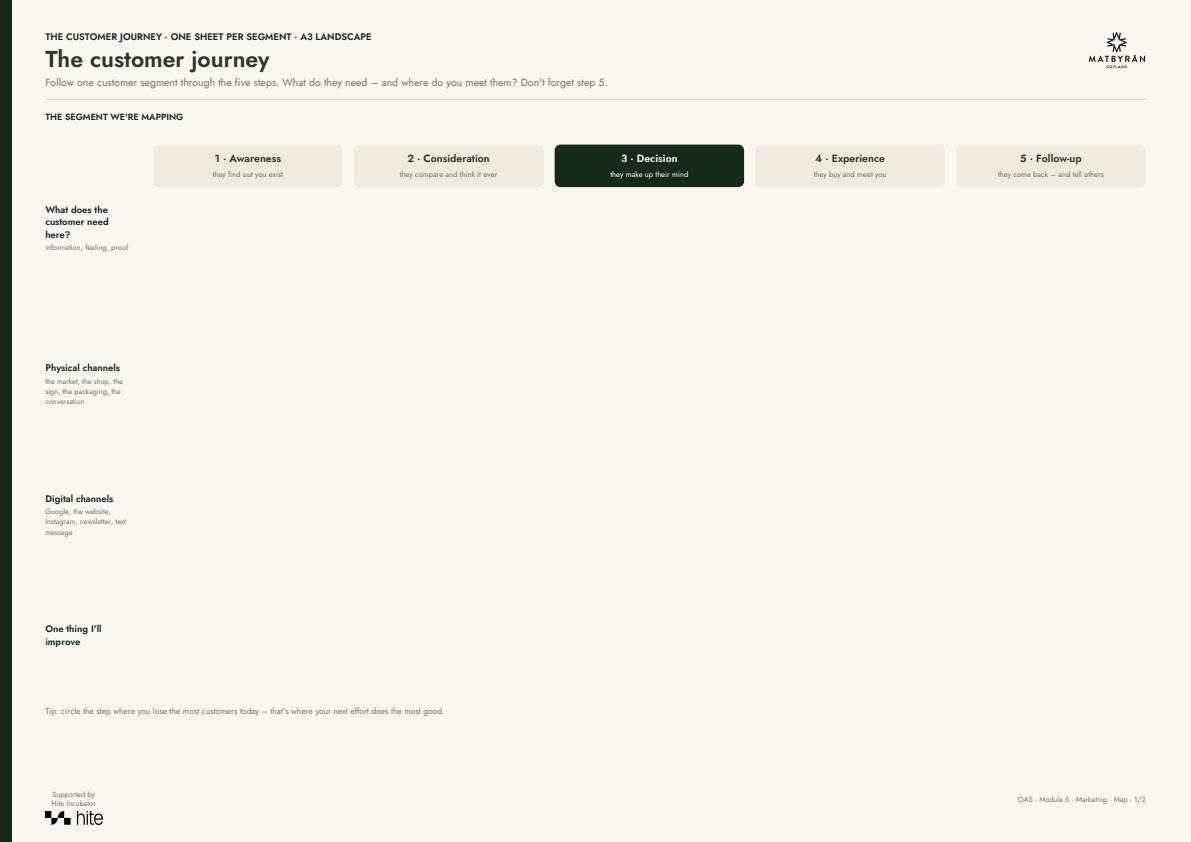
What you should have in hand: one filled-in journey map per segment – what the customer needs at each step, which physical and digital channels meet them there, and one thing to improve per step. Pay extra attention to step 5 – it's the one most often forgotten, and it's where the regulars are.
Do this next
Take your most important segment and fill in the map: what do you do at each step today, and where do you lose customers? Circle the step where you lose the most – that's where your next effort does the most good. Keep the map – you'll use it when you build your plan in step 6. Next step: being found in search, where much of awareness and consideration happens.